Biography

r e s e a r c h e r
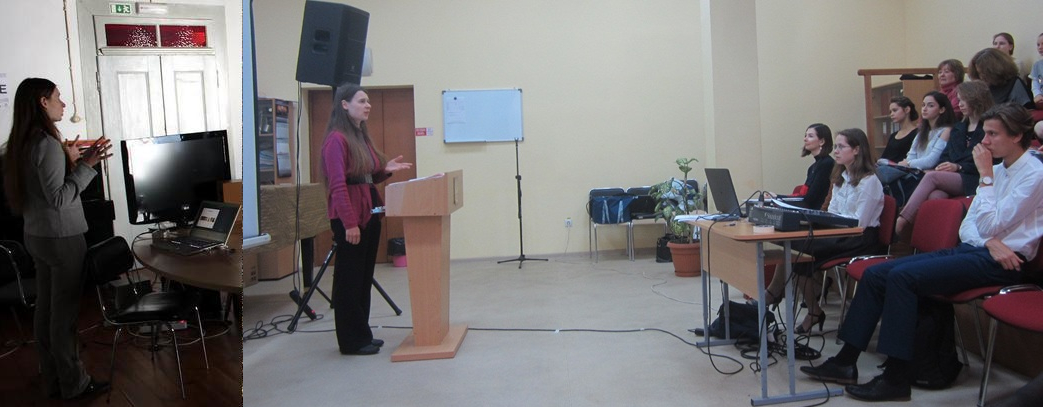
Olga Krashenko started her first research on "venio" being 8 years old when she invented this word. Many years later, Olga wrote an article on this topic, which was published in the Journal “Apocryph”.

Olga studied as musicologist at Kaliningrad Music College and continued at Saint-Petersburg State University (history and theory of performing arts) after she finished Saint-Petersburg conservatory as a composer. She gave seminars and lectures in Saint-Petersburg and in Moscow about Luigi Nono, Karlheinz Stockhausen, Gerard Grisey and other composers.

In Portugal at the festival "Dias de Música Electroacústica" in 2011, she presented a special theme "Music and Synesthesia". Olga subsequently returned to this topic many times, speaking at conferences and writing articles about it.

She was a finalist of the "INTERNATIONAL MUSICOLOGICAL CONFERENCE - Sociocultural crossings and borders: musical microhistories" at Lithuanian Academy of Music and Theatre (Vilnius) as well as a winner of SOUND/IMAGE (University of Greenwich, London), KEAMSAC (the Conference and the Journal of the Korea Electro-Acoustic Music Society) and Journal of International Computer Music Conference in Seoul, South Korea.

Olga Krashenko is author of the books "Research on Musical Holes" (2024), "Unexisting Music" (2015) and "River of Thoughts. To think is already to sound" (2013). Her books were presented in Italy, in Lithuania, in France and in Russia.

For two years she participated in Paris in the Lacanian cartel "Psychoanalysis and Music" of the Ecole de la Cause Freudienne. On this theme, she presented her paper "What and how we hear" in Saint-Petersburg at the Freudian Museum as well as wrote the articles "La Parole et La Musique" and "La Parole et le Son Musical". Olga Krashenko's works have been published in Lacanalia, Hebdo-blog, Remusik and other journals.

Featured works

2024

Book "Research on Musical Holes"

In my book "Research on Musical Holes", I developed a method of musical thinking that goes beyond traditional musicology. The book researches the contradictions, paradoxes and missing elements in music as a concept and all extra-musical elements connected with it. Many such things are usually not addressed in studies that try to present music theory in the form of clear, precise distinctions. In this book, familiar musical concepts are subjected to deconstruction, a search for contradictions and ambiguities, and discussions about what is missing (and, in general, about the concept of freedom due to absence). Musical holes will be identified and made analyzable. If one is sure that the definition of music and its components, as well as, the process of its creation and the localization of its sounds in space and time, are all somethings that are very obvious and simple, then this book will give rise to doubts, rethinking, and a radical new look at music as concept and sonic phenomenon. This could be the equivalent of certain logical paradoxes in philosophy and the unconsciousness as blind spots and half-truths in Lacanian psychoanalysis.

2023

Opera "Tintagiles"

The video-opera «Tintagiles» is based on the play of Maurice Maeterlinck «The Death of Tintagiles». The video-opera genre combines sound and motion by creating a fusion made with synesthesia in the case of this composition. The opera includes 7 characters with electronics (multi-channel tape) and a special video. The length of the opera is 2 h. 30 min. The form consists of 5 acts as well as a prelude, a postlude and 4 interludes.

2021

CD of the opera "Macondo"

Sound poetry libretto written by Olga Krashenko, inspired by Gabriel Garcia Marquez. Opera for 4 soloist-instrumentalists, choir, ensembles, orchestras and concrete sounds. Soloists: members of the ensemble C.L.S.I. (Circle for the Liberation of Sound and Image). Vocal, instrumental and concrete sounds composed and recorded by Olga Krashenko. The opera is dedicated to the memory of the writer G.G. Marquez.

Article

Synesthesia of Sound in Colour and Motion

on the example of video-opera “Tintagiles”

If at the neurophysiological level we are dealing with the borderline state of different zones and their intersection, which is typical for synesthesia, then in the field of art, the genre of opera already initially allows you to combine different ways of perception into one experience, thus overcoming the resulting separation and fragmentation of specializations in art and recreating the synthesis with the help of modern means and technologies.

Today opera continues to be relevant, and not only within the walls of opera houses, but also beyond them. The opera “Tintagiles” based on Maurice Maeterlinck's play “The Death of Tintagiles” is an example of a video opera (2017-2022) in which textual, musical and light-color symbols are synesthetically combined with the help of modern sound and video recording technologies and where their interweaving covers the whole range of possible associations, from the literal to the distant and abstract.